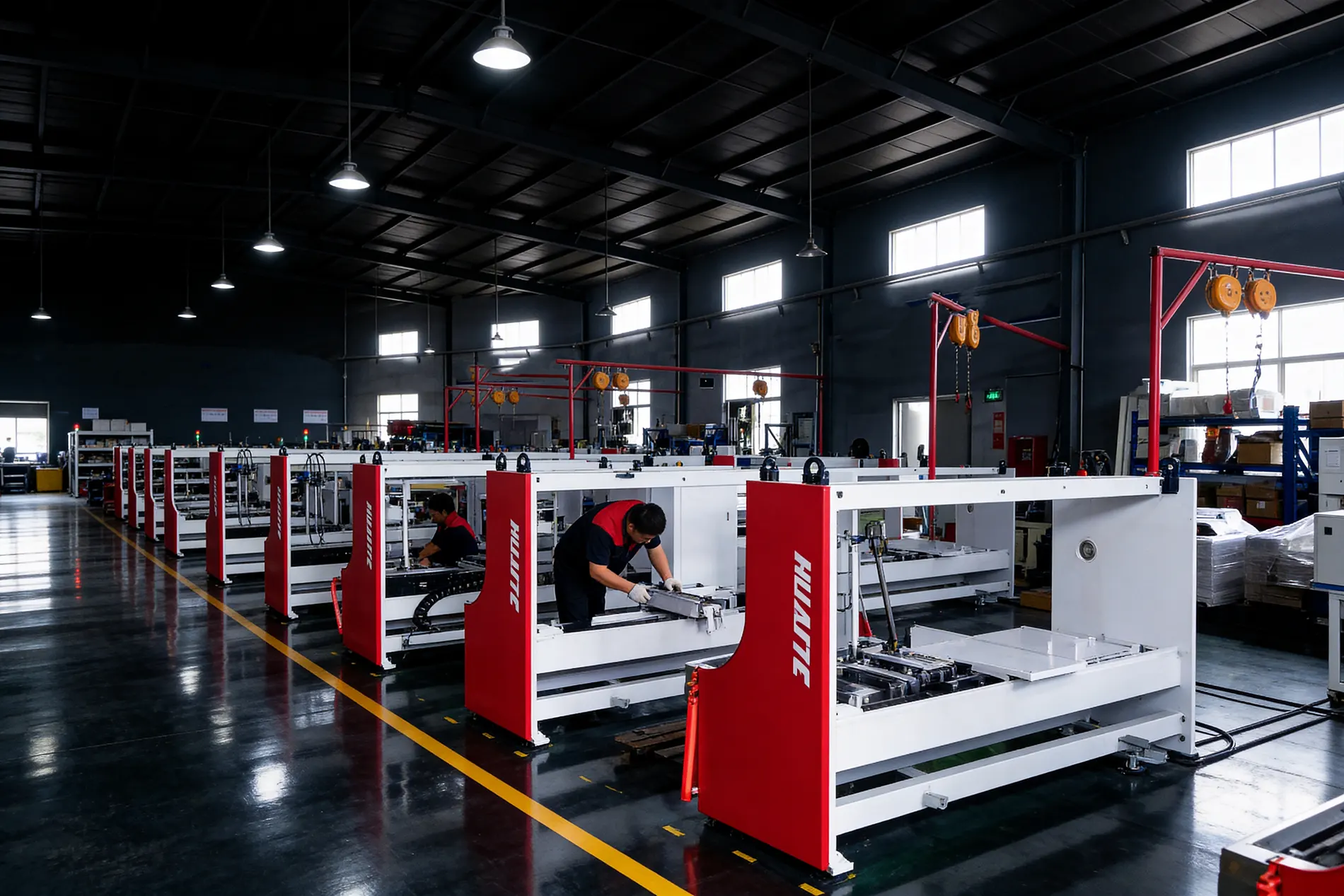
The tape e-commerce businesses in Yiwu share a common characteristic: they handle dozens of orders daily with varying widths and lengths, frequently changing orders, and require each roll of tape to have a perfect appearance and consistent label placement. Such a production environment places extremely high demands on cutting machines.
In the past six months, the White F6C fully automatic cutting machine has sold over 200 units in Yiwu, becoming the "standard configuration" for local tape e-commerce. We interviewed three typical users to see why they chose this equipment.
User One: Changing orders 25 times a day, F6C makes adjustments no longer a bottleneck
Mr. Zhang, a tape e-commerce business owner in Yiwu, explained that previously, using an old-style cutting machine, he changed orders 25 times a day, with adjustment times exceeding 3 hours. After switching to the F6C, the one-click parameter switching function reduced each adjustment time from 22 minutes to 2.5 minutes, gaining an additional 5 hours of production time each day. "Before, we could only ship by 10 PM; now we can finish by 5 PM, making it much easier for the workers."
User Two: Strict e-commerce evaluations, appearance must be perfect
On e-commerce platforms, the appearance of tape directly affects the positive review rate. The F6C is equipped with a dual-servo fully automatic labeling system, ensuring that the labeling position error is less than 2mm, and the labels are flat without curling. Additionally, the blade burrs are controlled within 0.05mm, resulting in smooth edges. A Tmall tape store owner reported: "After switching to tape cut by the F6C, our packaging rating from customers increased from 4.2 stars to 4.8 stars."
User Three: Thin profit margins on small orders, labor costs must be saved
The F6C's automatic shaft change, automatic labeling, and automatic material retrieval functions allow one worker to oversee 2 to 3 machines simultaneously. A factory owner with 10 cutting machines calculated: "Previously, 10 cutting machines required 12 workers (including order changes and packaging), but now only 5 workers are needed, saving over 400,000 in labor costs annually."
Conclusion: The popularity of the F6C proves that B2B equipment can become a "hot item" in a specific niche market. The key lies in whether it accurately addresses the unique pain points of that market.